
D.I.Y. Plans
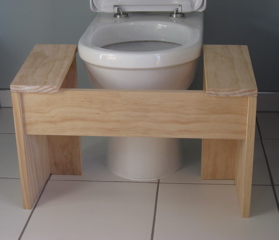
The plans are for the squarish model in the photos on this page.
Please read this page before purchasing for US$8
https://youtu.be/BDvWivNl9TA
Click on this link or copy and paste the above code into your browser to view the D.I.Y. Lillipad Squat Stool video.
Watch the 8 minute long video and decide if you (or your woodworker) have the minimal tools and materials necessary to make the Lillipad squat stool.
The video is aimed at the beginner, and has subtitles. The video lets you know what to expect before you purchase the plans.
The easily referenced plans have 5 pages of more detailed explanation, photos and drawings, and space to add your toilet's dimensions. The plans combined with the video make the building process fun, and throws a couple of bucks my way for my efforts : )
“I am a believer, and I built this toilet about five months ago, and have been using it continuously since.” Kit Laughlin, Australia
https://kitlaughlin.wordpress.com/2013/05/03/the-virtues-of-the-squat-toilet-and-why-we-need-not-be-deprived-in-the-west/
“Thank you so much for providing an affordable way to have a squatting platform, & for the pride of having built it myself. I've been perching on toilet rims for close to two months, and in that time, I rid myself of an inguinal hernia that I was told only surgery would fix.”
Happy squatting,
G.T. (USA)
“I actually had so much fun building my own personal custom Lillipad today, I might just build my friend one as a gift. After buying the plans around noon (1st test flight was around 7 PM this evening) and it works like a charm!
Well done and thanks again!”
Matt (USA)
Read here first to see if the DIY plans are a good option for you to build your own squat stool.
The homemade squat stool plans enable customisation of the footpad angle, height and width.
The printable PDF file includes, plans, timber selection advice, measuring advise to customise your squatting platform, helpful woodworking tips and a step-by-step guide and link to the accompanying video.
I have made the plans as simple as possible. Experienced woodworkers will be able to make improvements as they see fit.
Please note that some stores offer a cutting service and will be able to cut your wood to your measurements.
If you feel daunted by a lack of skill, equipment or space, I suggest asking someone capable to build it for you. They may already have the materials and it may only take them an hour or two to make.
Either way, you will need to measure your toilet as outlined in the squatting platform plans.
Will a squatting platform fit my toilet and bathroom?
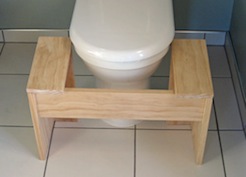
The wall in front of the toilet should be no closer than 300 mm (12 in.), and the wall to the side of the toilet, no closer than 120 mm (5 in.)
Check that the floor around the base of the toilet is flat, to ensure that the squatting platform has a stable footing.
Workspace
Work on a solid, flat surface with good lighting. It will take about two hours to make the squatting platform, once materials and tools are gathered.
Tools

You will need a sharp handsaw, sandpaper (150 grit), wood plane (optional), pencil, ruler, drill, 4.5 mm and 2.5 mm drill bits, 20 x 45 mm (1 ¾ in.) long wood-screws, a square, screwdriver (to fit the wood-screws), wood glue, filler to fill the head of the screws (optional). To finish your squatting platform you can use wood oil, polyurethane or paint.
The plans are for the squarish model shown directly below and plans are written in English.
This set of plans is protected by international copyright laws. Their use is made upon the condition that they will be consulted for private use only. Any copying or re-selling in the whole or in part is prohibited unless expressly authorised. This prohibition may be enforced by legal action. © 2023 Lillipad Ltd.
Plans are written in English.
Once plans are purchased, a download link will be sent to you via paddle.com. Our order process for purchasing these Plans is conducted by our online reseller Paddle.com. Paddle.com is the Merchant of Record for these plans only. Paddle provides all customer service inquiries and handles returns for these plans only.
Proceed by clicking the “buy plans now” button below.

© 1991 - 2025 Robert Wait, Lillipad Ltd.